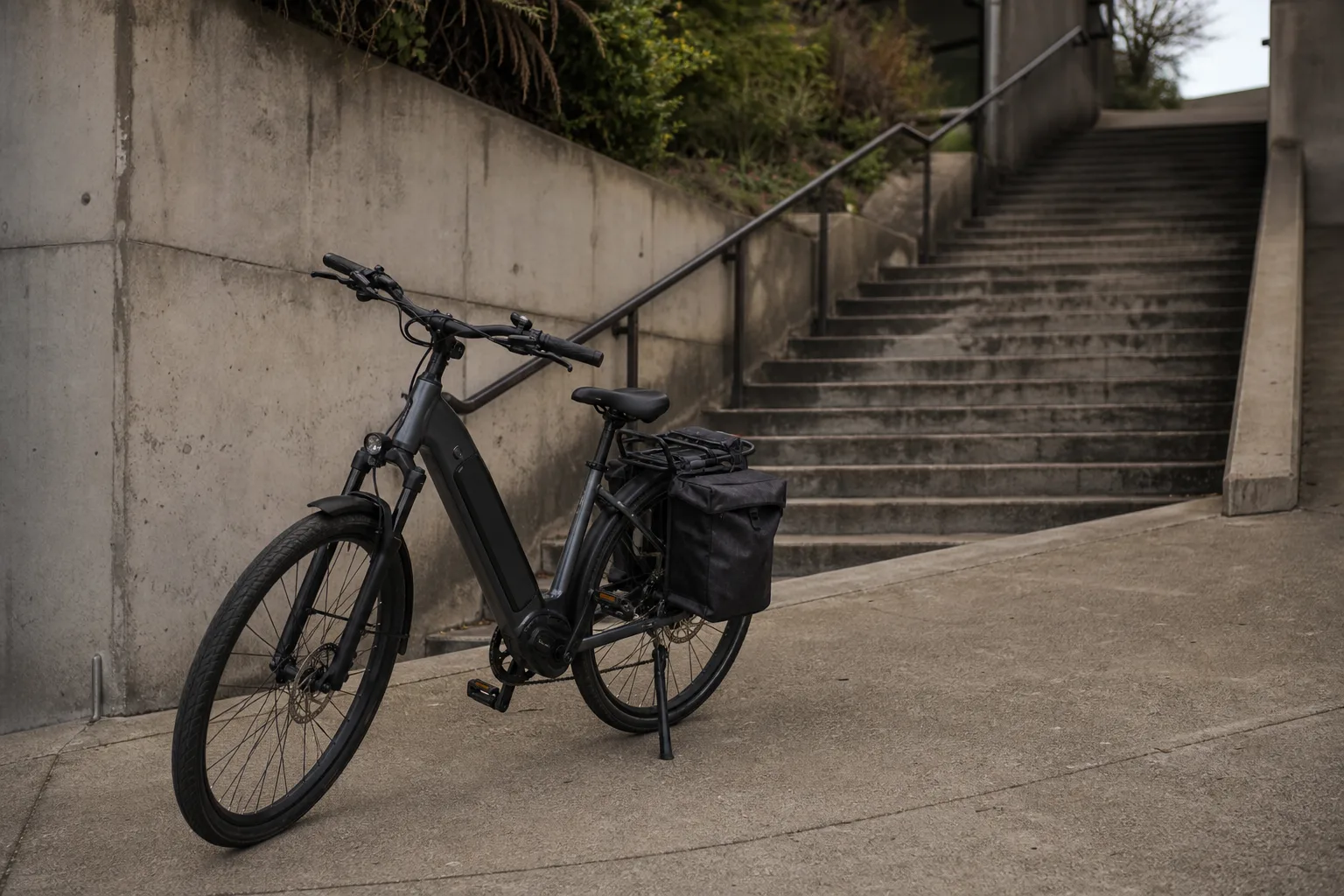
The useful first move is not opening four browser tabs of motor wattage. It is walking or driving the route you will ride four or five days a week, with a phone recording the elevation, and noting where the bike will sleep at the end of it. That single hour of homework eliminates more models than any comparison chart, because a bike is not fast or slow or good value in the abstract. It is those things against one grade, one distance, one doorway, and one flight of stairs. Everything else is preference.
The steepest hundred yards decides the drivetrain
Average gradient over a commute tells you almost nothing, because you do not suffer averages, you suffer the worst pitch on the worst day with groceries on the rack. Find that pitch and measure it honestly, ideally with a mapping app that reports grade rather than a guess from memory. A route with a sustained double-digit climb pushes you toward a mid-drive motor and a wide gear range, which costs real money over a hub motor, often several hundred dollars at similar build quality. A route that is flat with two short rises does not, and paying for the climb you never make is the most common overspend in this category.
The cost of getting this wrong runs both directions, which is why it deserves the measurement. Underbuy and you overheat a hub motor on the one hill you cannot avoid, grind up it in a single hard gear, and start dreading the ride you bought the bike to enjoy. Overbuy and you carry weight, complexity and a service bill you did not need, since mid-drives eat chains and cassettes faster under torque. The tiebreaker is frequency. A brutal grade you climb twice a year is a walking problem; a moderate one you climb twice a day is a drivetrain problem.
Distance sets the battery, and the round trip is the real number
Range claims are written for a light rider on flat ground in low assist, and your commute is none of those things. Work in watt-hours and in round trips, not one-way miles, because the trip that strands you is the one home at 6 p.m. after you forgot to plug in at the office. Then decide whether you will charge at both ends or only one, since that choice can halve the battery you need to buy. A larger battery costs money at purchase and weight forever, and weight matters more than most buyers expect once stairs enter the picture.
There is a second-order cost worth naming here. Battery capacity you rarely use still ages, and a pack cycled shallowly and stored sensibly outlives one run flat every day, so a slightly oversized battery on a short commute can be the cheaper long-run decision. The Consumer Product Safety Commission oversees the safety of consumer products including the lithium batteries in these bikes, which is a good reason to buy a pack and charger sold as a certified system rather than the cheapest replacement you can find later. Charging habits are part of the purchase, not an afterthought.
Where it parks, and whether you lift it
Ask where the bike lives before you ask what it costs. A ground-floor garage with an outlet makes weight nearly irrelevant and opens the whole market, including heavy cargo models with big packs. A third-floor walkup with no elevator does the opposite: it rules out anything over roughly fifty pounds unless you plan to carry the battery separately, and it makes a removable pack a requirement rather than a nice feature. Street parking overnight changes the calculation again, pushing you toward a bike you can afford to have stolen and toward a lock budget that is a real line item.
Storage also drives the frame. A step-through is easier to load in a tight hallway and easier to mount when the rack is full, and a folding bike solves an apartment problem while adding hinges and a harsher ride. Once these constraints are written down, browsing gets short and honest, and shopping a broad catalogue of electric bike for adults options becomes a matter of filtering to the handful that fit rather than admiring the ones that do not. Most of the market disqualifies itself on geometry and weight before price is ever discussed.
What ordering the decision this way saves you
The savings are not only in the purchase price, though that is where they show up first. Fitting the bike to the route reduces the odds of the expensive correction, which is selling a barely used bike at a steep loss six months in and buying the right one anyway. It also shortens the test-ride list to three or four candidates, which means you can ride each one on your actual hill instead of a flat parking lot behind the shop. Shops will usually allow that if you ask. The hour of measurement buys you a far better test.
None of this requires expertise, only sequence. Grade first, round trip second, parking and lifting third, and only then motor, battery and price, at which point the specifications finally mean something because you know what you are asking them to do.