Five things that wear out on an e-bike, and who will actually fix them
Mill Road Rise- Subject
- choosing, sizing and living with an electric bicycle used for adult everyday transport
- Editor
- The Mill Road Rise team
- Subject
- choosing, sizing and living with an electric bicycle used for adult everyday transport
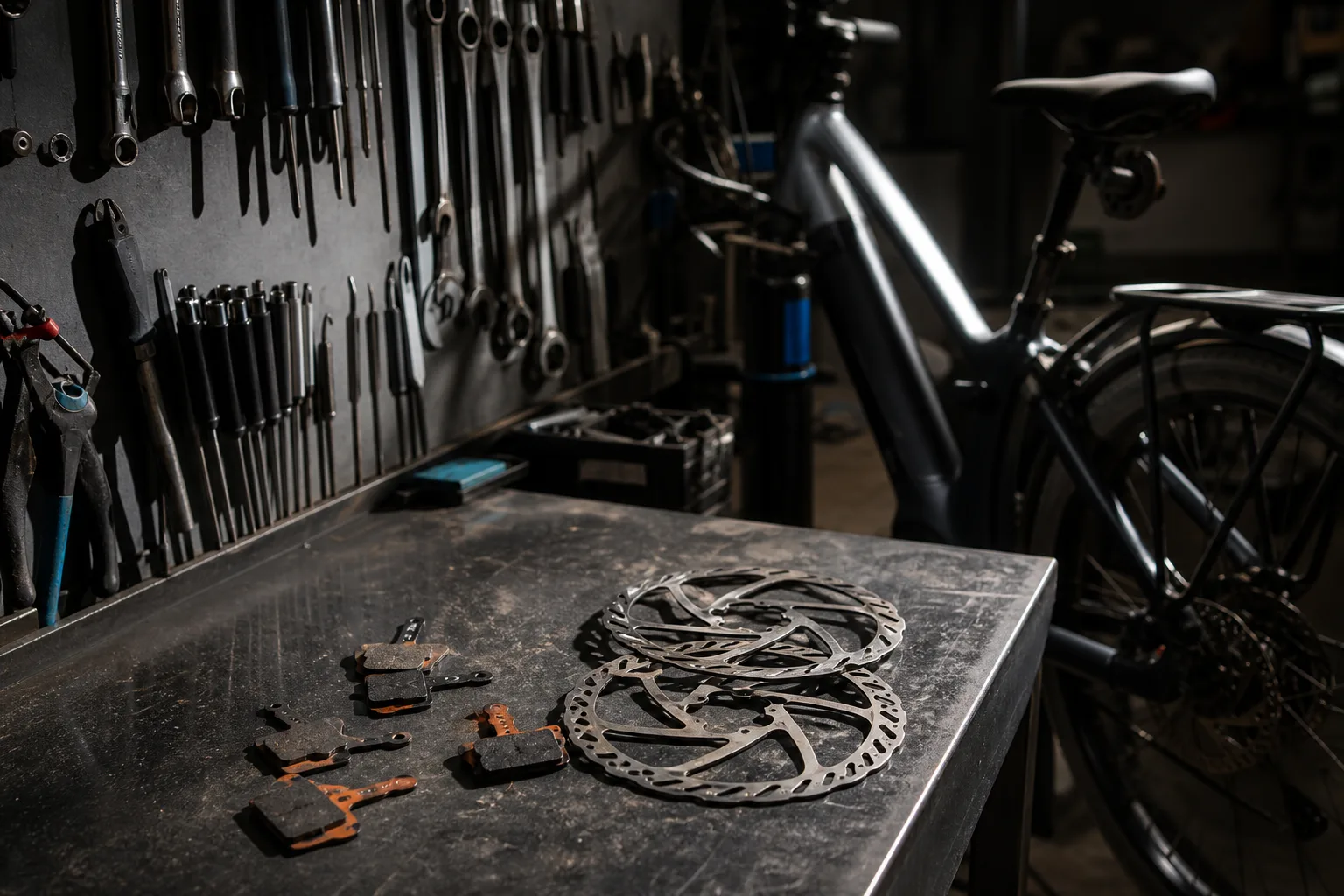
An e-bike combines a bicycle that wears out steadily with an electrical system that mostly fails suddenly. Budgeting for one and not the other is how owners get surprised.
A commuter e-bike is two machines bolted together, and they age on different clocks. The mechanical half wears the way any bicycle wears, only faster, because the parts are carrying more weight at higher average speed. The electrical half mostly does nothing for years and then fails in a way that is either a ten-minute connector fix or a dead end, depending entirely on whether the manufacturer still sells the piece. A careful reader checks both halves before buying, not after, because the second half is where the bike quietly becomes disposable.
1. Brake pads, rotors and tires, which go quicker than you expect
Weight and speed set brake wear, and a loaded e-bike with a rider, a pannier and a battery is heavier than almost anything else on the bike path. Expect to replace pads more often than on an analog bike, and expect rotors to need attention sooner too, particularly on a hilly route where you are braking against gravity rather than just scrubbing momentum. Tires are the same story: heavier casings, more punctures found, more frequent replacement. None of this is expensive individually, and every bike shop in the country can do all of it.
2. Chains and sprockets, where mid-drives cost more than hub motors
On a mid-drive, motor torque runs through the chain, cassette and chainring, so the drivetrain wears at a rate closer to a touring bike carrying heavy loads than a commuter bike. A chain checker reading past 0.5 percent elongation is the cue to swap the chain; ignore it to 0.75 percent and you usually buy a cassette as well. Hub-drive bikes spare the drivetrain entirely, because the motor never touches it. That difference shows up as a recurring annual cost, modest per visit, real over five years.
3. Controllers, displays and wiring harnesses, which fail as units
The parts a normal bike does not have tend not to wear so much as stop. Controllers fail from water intrusion or heat, displays crack or go dark, and wiring harnesses chafe where they enter the frame. Almost none of these are repairable at component level by a bike shop, so the fix is a replacement module and a firmware pairing step. Bikes built around a widely distributed drive system usually have those modules in a distributor's warehouse. Bikes built around an unbranded system usually do not, and that is the whole difference.
4. The battery, which is the biggest single number you will face
Cells lose capacity with cycles and with calendar age, and a pack that starts at a given range will hand back noticeably less after several years of daily charging. A replacement pack is typically the largest maintenance expense in the life of the bike, often a substantial fraction of what the bike cost new, which is why the availability question matters more than the price question. Ask whether the pack is a standard mounting format, whether third parties build compatible cells, and whether the seller will still list it in five years.
5. The shops that say no, and how to find the ones that say yes
Plenty of independent shops decline electrical work outright, and their reasons are sound: liability on lithium packs, no dealer login for diagnostics, no training on a given drive system, and no way to source a sealed part they cannot buy. Many will happily do brakes, tires and drivetrain on any e-bike while refusing to open the motor or touch the battery. Before you buy, call two shops within riding distance, name the specific drive system, and ask what they will and will not work on. Their answers are more useful than any spec sheet.
6. Judging a brand's parts supply before you spend the money
Look for a public parts catalog with prices and part numbers, not a contact form. Check whether displays, controllers, speed sensors and chargers are listed individually rather than only as complete bikes. Look at how long the current model platform has been sold, since a system in its fourth year has an installed base worth supporting. Warranty terms are worth reading closely, and the Federal Trade Commission is the agency responsible for how consumer product warranties are presented and honored, which makes the written document the one that counts.
The pattern that holds up across brands is simple enough to check in an afternoon: standard mechanical parts, a drive system with a distributor behind it, a pack you can still buy, and a shop nearby that has said yes out loud.
Brake pad interval. Extra system weight and higher average speeds shorten pad life compared with an unassisted commuter. Riders on hilly routes should expect to check pads several times a year rather than annually.
Rotors wear too. Repeated heavy braking thins rotors as well as pads, and a thin rotor makes even fresh pads feel vague. Most rotors carry a minimum thickness stamped on them.
Chain checker economics. Replacing a chain at 0.5 percent elongation usually saves the cassette; waiting until 0.75 percent usually does not. The gauge costs less than a single cassette.